


Sydney Property Market Forecast 2026: Strategic Insights for Brokers
Sydney is edging closer to a remarkable milestone, a $2 million median home price.
For many, that figure feels almost surreal. Yet, for brokers, it signals something else entirely: opportunity.
The Sydney property market forecast 2026 isn’t just about numbers, it’s about timing, positioning, and strategy.
If 2025 was about recovery and stabilisation, 2026 could be about acceleration.
Let’s break down the data, opportunities, and actionable insights that brokers can use to stay ahead.
The $2 Million Median and the Opportunity It Brings
Sydney’s property landscape continues to defy predictions. After a turbulent few years of interest rate hikes and cautious optimism, the city is once again showing resilience.
With migration rebounding, limited housing supply, and a surge in infrastructure projects, experts believe that Sydney is on track to reach a $2 million median by late 2026.
For brokers, this isn’t just another growth cycle, it’s the start of a competitive phase where market knowledge and client strategy will set the top performers apart.
Executive Market Summary – The Numbers at a Glance
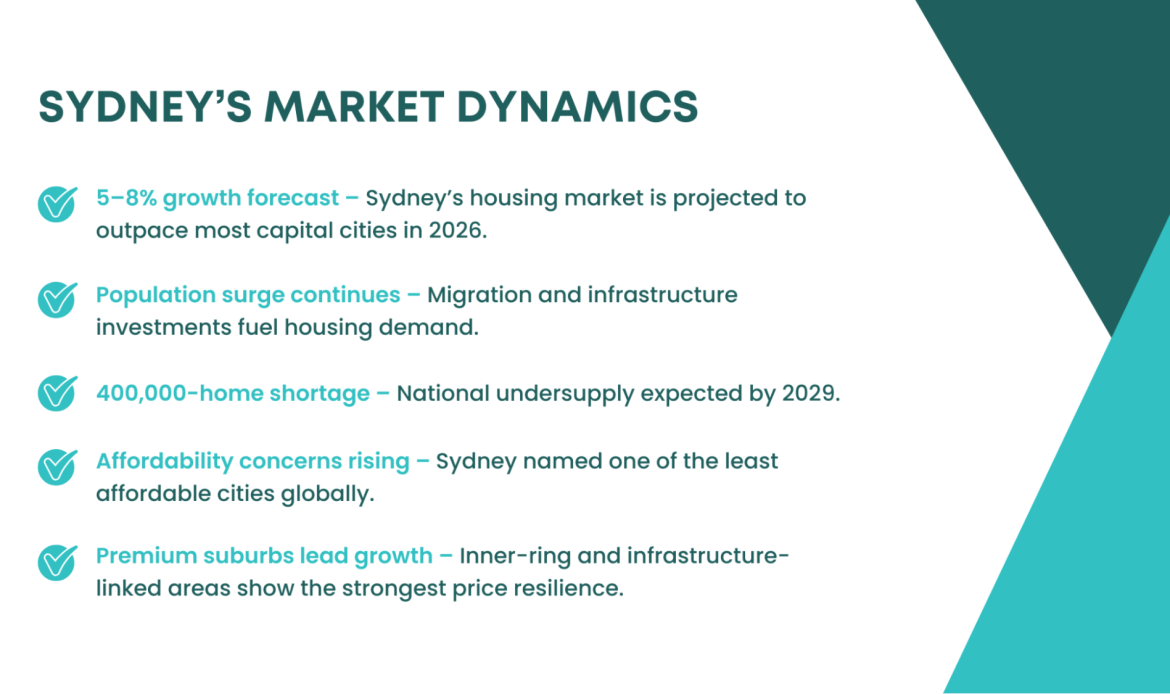
Analysts are expecting 5–8% price growth across Greater Sydney in 2026. The consensus among leading banks and research firms places the city’s median dwelling price between $1.68 million and $2 million by the end of the year.
Sydney’s home values are projected to climb further, with analysts expecting growth of up to 7% in 2026, potentially pushing the median towards $1.83 million. As reported by ABC News, this surge is set to mark a new record high for the city’s property market.
CoreLogic and Domain projections indicate inner-ring suburbs could see the strongest price momentum, while outer areas will maintain affordability-driven demand.
Market Drivers & Conditions – What’s Fueling 2026 Growth
Several underlying factors are setting the tone for 2026:
- Interest rates are expected to stabilise or decline slightly, unlocking buyer confidence.
- Supply constraints continue, with building approvals still below pre-pandemic levels.
- Population growth, especially migration into New South Wales, adds pressure to housing demand.
- The government’s 5% deposit scheme expansion is enabling more first-home buyers to enter the market.
Combined, these forces form a solid foundation for another year of steady appreciation in Sydney’s housing values.
The Affordability Paradox – Rising Prices vs. Accessibility
This is where things get interesting. While prices are projected to rise, so too is the conversation around affordability.For many buyers, the dream of owning in Sydney feels increasingly out of reach, but brokers can reframe this narrative.
Sydney has now earned the title of one of the world’s least affordable housing markets, with a dwelling price-to-income ratio nearing 15 times. This was reported in News, highlighting just how steep the affordability curve has become for local buyers.
By introducing clients to alternative lending products, explaining government incentives, or focusing on up-and-coming suburbs, brokers can turn affordability challenges into strategic opportunities.This tension, between growth and accessibility, will be one of 2026’s defining discussion points in the housing market forecast.
Fragmented Market – Sydney’s Multi-Speed Growth Story
Sydney’s growth story in 2026 won’t be uniform, it will be highly segmented. Let’s break it down:
- Affluent Sydney (Inner Ring Premium) – Areas like Mosman, Paddington, and Double Bay will continue attracting high-net-worth buyers, driven by lifestyle and scarcity.
- Professional Sydney (Middle Ring) – Suburbs such as Ryde, Strathfield, and Chatswood are benefiting from family demand and strong schooling catchments.
- Rising Sydney (Central Coast & Infrastructure-Driven) – Thanks to ongoing projects like the Western Sydney Airport and Metro extensions, regions such as Parramatta, Penrith, and Gosford are experiencing renewed investor interest.
- Suburban Sydney (Outer Middle Ring) – Blacktown, Marsden Park, and Campbelltown offer value for upgraders seeking larger homes.
- Heartland Sydney (Most Affordable) – The south-west corridor, including Liverpool and Leppington, remains attractive for first-home buyers.
Among these, several suburbs are expected to post 5%+ annual growth, highlighting why detailed property market insights are essential for every broker’s client briefings.
Investment Strategy Insights – Following the Smart Money
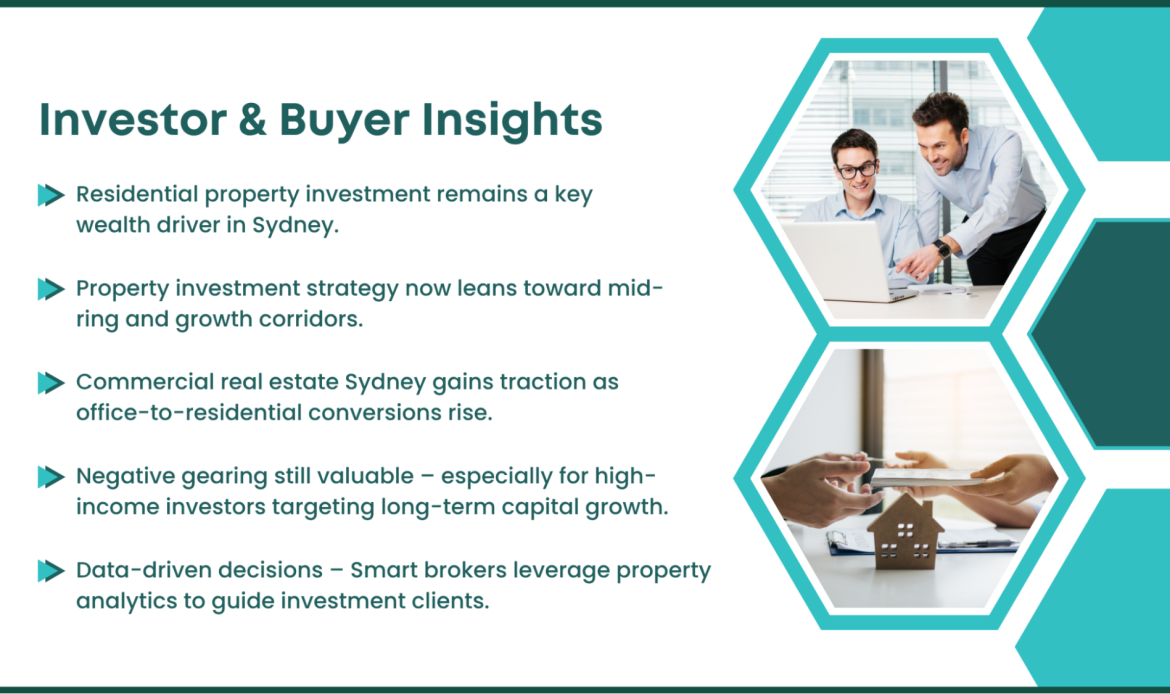
When it comes to property investment strategy, 2026 is shaping up to be a year of diversification.
Investors are looking beyond traditional capital growth and into hybrid returns, balancing yield and long-term appreciation.
Key trends include:
- Apartments and townhouses in growth corridors offering 4–5% gross yields.
- Negative gearing remains a central tax planning tool for higher-income investors.
- Residential property investment through SMSFs is gaining popularity, especially in high-yield outer suburbs.
- Increasing interest in commercial real estate Sydney segments, like warehouses, retail strips, and small offices, as hybrid work patterns evolve.
For brokers, this mix means broader client conversations and tailored loan structures.
First-Home Buyer Surge – Scheme Expansion and Broker Advantage
The expansion of the 5% deposit scheme is expected to inject thousands of new entrants into the market.
This policy-driven momentum could see the number of first-home buyers in Sydney rise by as much as 20% in 2026.
Brokers are uniquely positioned to capture this segment by:
- Running digital campaigns focused on eligibility education
- Partnering with developers in the outer middle ring
- Simplifying complex loan processes through tech and outsourcing partnerships
Positioning yourself as a trusted guide for this demographic could be a defining growth lever in 2026.
Technology & Market Intelligence – The Broker’s Competitive Edge
The brokerage industry is no longer just about product knowledge, it’s about market intelligence.
AI-powered tools are helping brokers analyse suburbs, identify high-probability borrowers, and anticipate client needs faster than ever before.
Those who embrace technology, from CRM automations to predictive analytics, will gain a decisive edge.
Combined with outsourcing administrative tasks, brokers can dedicate more time to client relationships and advisory roles.
This is where data-driven property market insights truly translate into client value.
Risk Factors & Market Headwinds – Keeping a Balanced View
While the momentum looks positive, every forecast carries cautionary notes. Key risks to monitor in 2026 include:
- Overheating risks, particularly in inner Sydney, where demand may outpace affordability.
- Interest rate volatility, even small upward shifts could dampen sentiment.
- Supply chain delays continue to affect construction timelines.
- Regulatory changes from APRA or ASIC that could influence lending limits or investor activity.
For brokers, staying aware of these shifts ensures timely client advice and proactive communication. The supply shortage remains one of the strongest tailwinds for price growth. Australia is on track to face a shortfall of more than 400,000 homes by 2029, as reported by Real estate.
Broker Action Plan – From Insight to Implementation
Turning knowledge into strategy is where top brokers thrive.
Here’s how to translate the 2026 outlook into real business impact:
- Client Segmentation: Categorise clients into investors, first-home buyers, and refinancers, with tailored approaches for each.
- Marketing Messaging: Use data-driven storytelling, clients respond to insights, not just listings.
- Service Delivery Enhancements: Outsource file processing, leverage tech tools, and reduce turnaround times.
- Suburb-Specific Briefings: Create quick reference sheets highlighting top-performing areas, average yields, and buyer demand indicators.
As deal volumes and compliance demands rise, working with an outsourcing partner like Brokers Support Global is becoming a strategic move. These simple adjustments can dramatically enhance credibility and close rates.
Conclusion – The Broker Opportunity in 2026
As Sydney edges closer to the $2 million median milestone, the city’s property landscape remains dynamic, resilient, and full of opportunity.
The Sydney property market forecast 2026 makes one thing clear: informed, proactive brokers will lead the next wave of growth.
With a blend of economic understanding, technological leverage, and client-first strategy, brokers can position themselves not just as intermediaries, but as trusted market advisors.
Because in 2026, it’s not just about who sells the most loans.
It’s about who understands the market best, and helps clients make the smartest moves in a rapidly evolving Sydney property market. Partnering with an outsourcing partner like BSG can help firms stay ahead, managing the back office while you focus on relationships, strategy, and client growth.

About Aneri Shah
Aneri Shah is the Director at Brokers Support Global (BSG), where she leads operations focusing on back-office support for Australian mortgage brokers. With over 4+ years of experience, Aneri specialises in loan processing, mortgage packaging, serviceability calculations, and post-settlement services.